
Soft Matter Physics. Polymers. Experiments.
Come join our research group.
Roth Lab News
- Congratulations to Kelly (Juhyeong) Kim for winning 2nd place Best Student Poster at the 52nd North American Thermal Analysis Society (NATAS) meeting.
- Congratulations to Sartia Yadav, Alphin Joshy, and David Cai for giving great presentations at the 2026 Global Physics Summit in Denver, Colorado.
- Congratulations to Kelly (Juhyeong) Kim for successfully defending her Qualifier Proposal.
- Congratulations to Alex Couturier for successfully depending his PhD dissertation and starting his new career at Nanoscience Instruments.
- Congratulations to Alphin Joshy and David Cai for successfully defending their Qualifier Proposals.
- Research from the Roth lab highlighted in Emory News.
- Connie Roth is awarded a NSF Special Creativity Award, 2022.
- Connie Roth is named a 2019 Fellow of the American Physical Society (APS),
and received the Fellows Award from the North American Thermal Analysis Society (NATAS). - … see more news items →
Recent Publications
 See article →
Impact of Domain Size on the Length Scale of Local Glass Transition Perturbations Caused by an Immiscible Glassy-Rubbery Interface
A.A. Couturier and C.B. Roth
See article →
Impact of Domain Size on the Length Scale of Local Glass Transition Perturbations Caused by an Immiscible Glassy-Rubbery Interface
A.A. Couturier and C.B. RothACS Macro Letters 2025, 14, 1256–1262.
 See article →
Perylene Dye as a Measure of Dynamic Free Volume, Fragility, and Dynamic Glass Transition in Thin Polystyrene Films
S. Yadav and C.B. Roth
See article →
Perylene Dye as a Measure of Dynamic Free Volume, Fragility, and Dynamic Glass Transition in Thin Polystyrene Films
S. Yadav and C.B. RothMacromolecules 2026, 59, 2894–2905.
 See article →
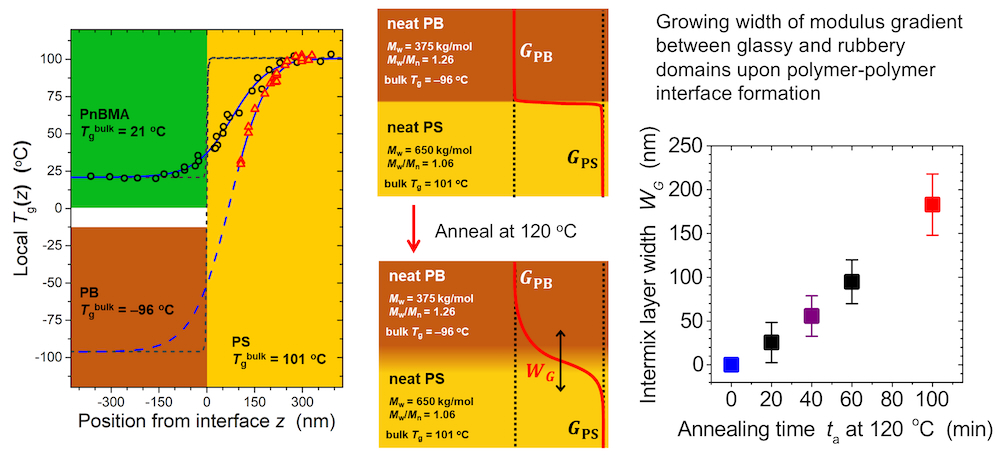
Narrow Acoustic Impedance Matching Layer Accelerates Long-Range Coupling of Local Modulus Between Glassy and Rubbery Polymer Domains
A.A. Couturier, D.B. Cai, J.C. Burton, and C.B. Roth
See article →
Narrow Acoustic Impedance Matching Layer Accelerates Long-Range Coupling of Local Modulus Between Glassy and Rubbery Polymer Domains
A.A. Couturier, D.B. Cai, J.C. Burton, and C.B. RothJournal of Chemical Physics 2026, 164, 164902.
 See article →
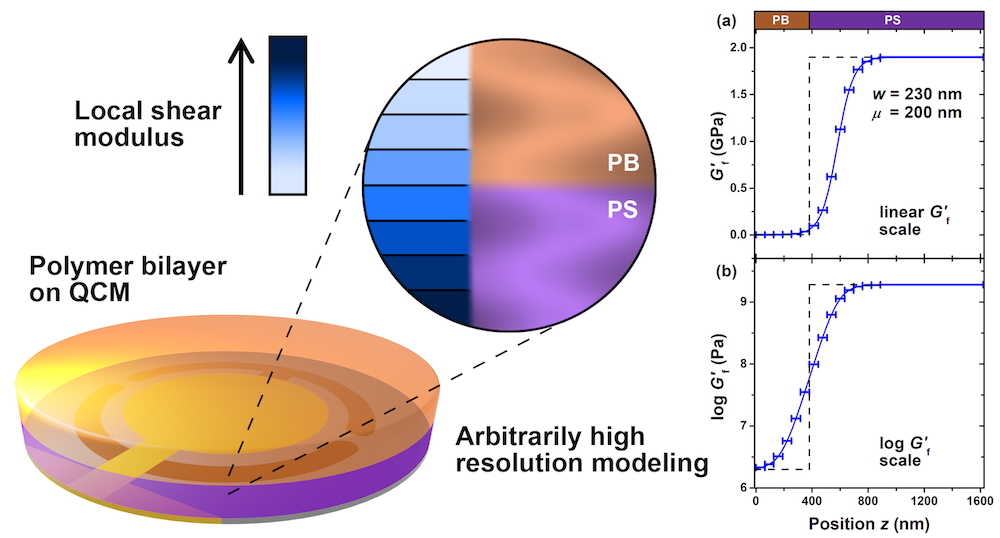
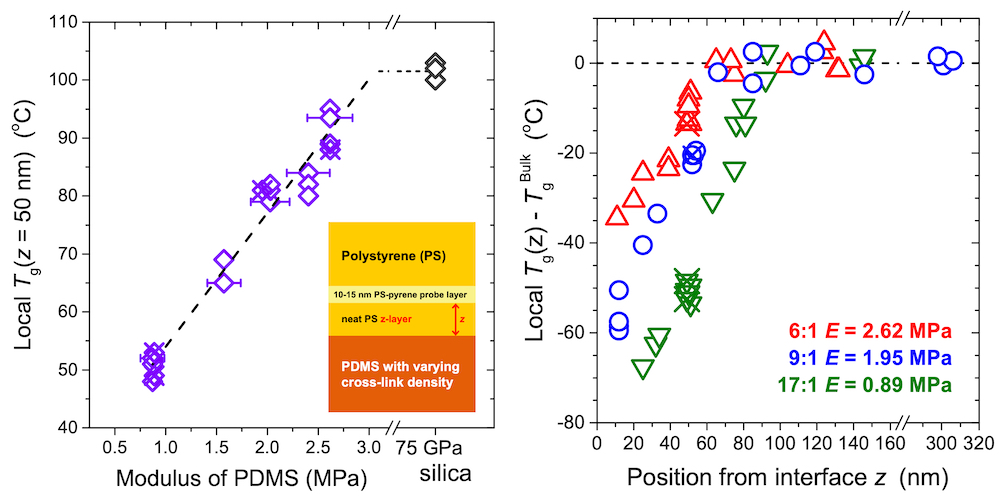
Development of broad modulus profile upon polymer–polymer interface formation between immiscible glassy–rubbery domains
Y.J. Gagnon, J.C. Burton, and C.B. Roth
See article →
Development of broad modulus profile upon polymer–polymer interface formation between immiscible glassy–rubbery domains
Y.J. Gagnon, J.C. Burton, and C.B. RothProceedings of the National Academy of Sciences 2024, 121, e2312533120.
 See article →
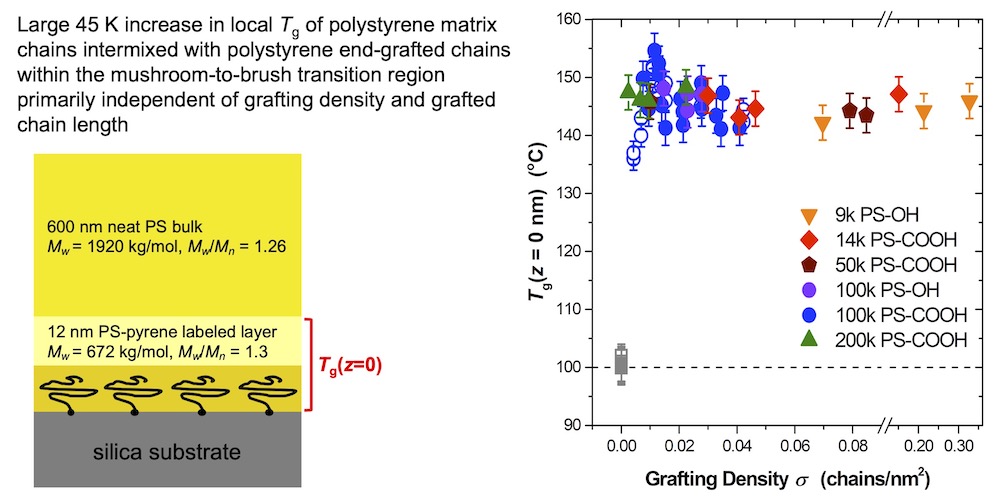
Analyzing QCM Data Using a New Transfer-Matrix Model: Long-Ranged Asymmetric Gradient in Shear Modulus Identified Across Immiscible Glassy-Rubbery Polymer Interface
A.A. Couturier, J.C. Burton, and C.B. Roth
See article →
Analyzing QCM Data Using a New Transfer-Matrix Model: Long-Ranged Asymmetric Gradient in Shear Modulus Identified Across Immiscible Glassy-Rubbery Polymer Interface
A.A. Couturier, J.C. Burton, and C.B. RothMacromolecules 2025, 58, 3520–3536.
 See article →
End-Tethered Chains Increase the Local Glass Transition Temperature of Matrix Chains by 45 K Next to Solid Substrates Independent of Chain Length
J.H. Merrill, R. Li, and C.B. Roth
See article →
End-Tethered Chains Increase the Local Glass Transition Temperature of Matrix Chains by 45 K Next to Solid Substrates Independent of Chain Length
J.H. Merrill, R. Li, and C.B. RothACS Macro Letters 2023, 12, 1.
 See article →
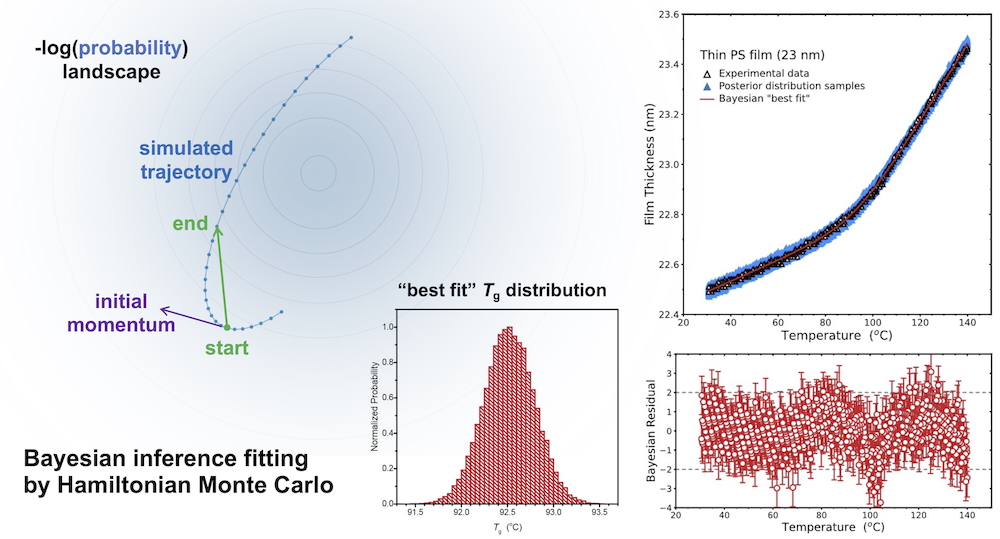
A Bayesian Inference Approach to Accurately Fitting the Glass Transition Temperature in Thin Polymer Films
J.H. Merrill, Y. Han and C.B. Roth
See article →
A Bayesian Inference Approach to Accurately Fitting the Glass Transition Temperature in Thin Polymer Films
J.H. Merrill, Y. Han and C.B. RothMacromolecules 2024, 57, 11055.
 See article →
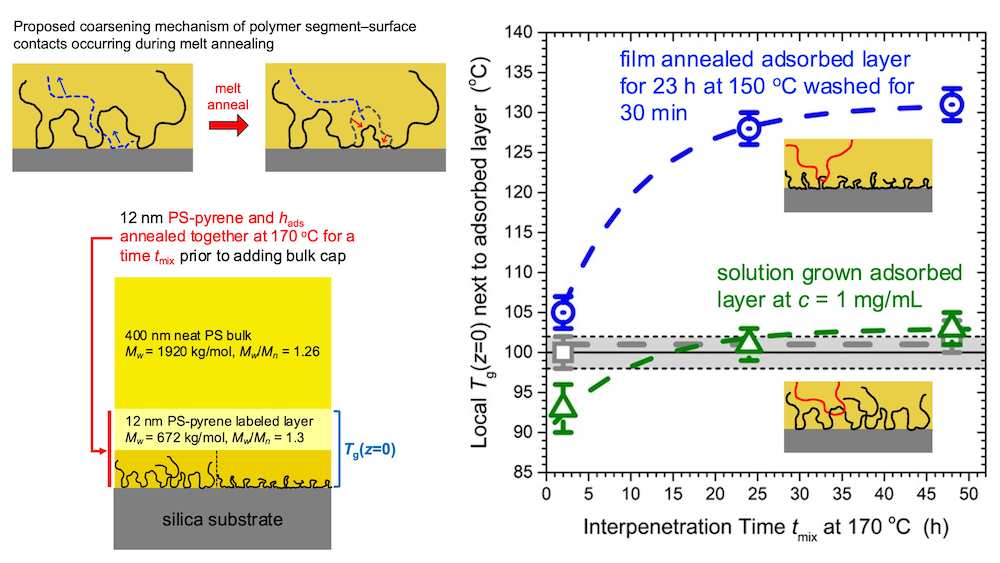
Comparing the Impact of Different Adsorbed Layers on the Local Glass Transition of Polymer Matrices
M.F. Thees, J.H. Merrill, X. Huang and C.B. Roth
See article →
Comparing the Impact of Different Adsorbed Layers on the Local Glass Transition of Polymer Matrices
M.F. Thees, J.H. Merrill, X. Huang and C.B. RothJournal of Chemical Physics 2024, 160, 044908.
Current Research Areas
Coupled Dynamics Across Polymer Interfaces
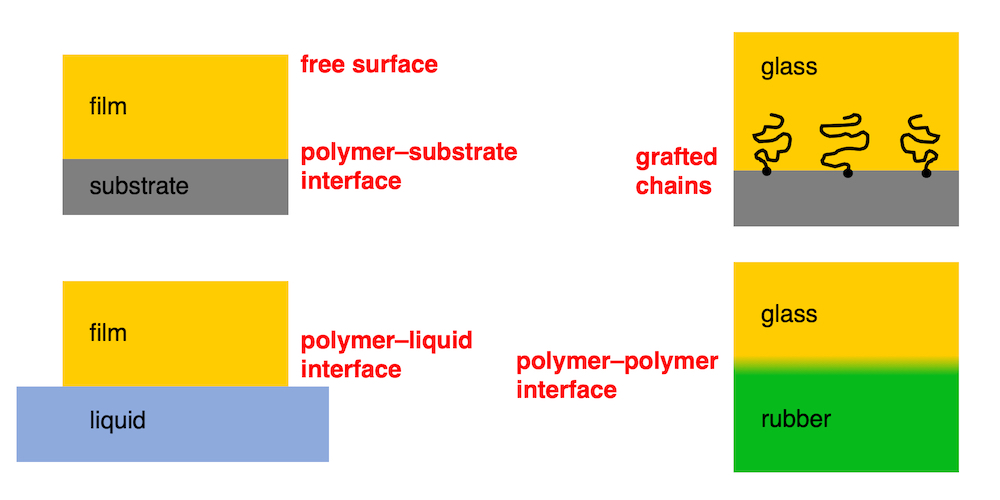
Recent work from our lab has uncovered broad profiles in local Tg(z) across glassy-rubbery polymer interfaces demonstrating glass transition dynamics can become coupled between neighboring polymer domains over long distances. Current efforts are aimed towards understanding the cause of this unexpected phenomenon.
Impact of Surface Bound Chains
We are working on understanding the unexpected large increases in local Tg(z) that occur next to surfaces with tethered chains. Grafted and adsorbed polymer chains are widely used to modify interfacial interactions in polymer materials and nanocomposites, but the underlying mechanisms by which this causes property changes to the neighboring polymer matrix are not well understood.
Nanoscale Measures of Local Properties
An ongoing focus of our lab is the development of new experimental methods to measure localized polymer properties at nanoscale dimensions in an effort to understand how their perturbed behaviors near interfaces are interrelated.
Polymers in Art Conservation
In collaboration with Chief Conservator Renée Stein at Emory’s Carlos Museum, our lab is characterizing polymers used in the preservation and restoration of artworks in an effort to understand how their preparation conditions impact their properties.
Polymer Glasses